
Wisdom Beyond Jargon: President Prabowo Subiantos chant of “Free Palestine
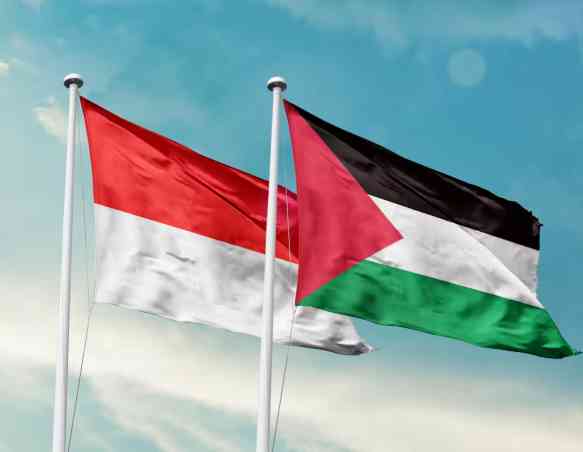
Wisdom Beyond Jargon: President Prabowo Subianto’s chant of “Free Palestine
President Prabowo Subianto’s chant of “Free Palestine” at Pondok Modern Darussalam Gontor on September 19, 2026, became a headline easily interpreted as a shift in posture. Almost a year earlier, Prabowo concluded his speech at the UN General Assembly with the word “Shalom,” after stating that Palestinian-Israeli peace requires the recognition of a Palestinian state alongside guarantees for Israel’s safety and security. The contrast is indeed journalistically compelling. However, such gestures cannot automatically be simplified as a fundamental shift in foreign policy.
In September 2025, Prabowo did not merely utter “Shalom” as a nod to Israel. In that same speech, he unequivocally reaffirmed Indonesia’s full support for the two-state solution and Palestinian independence. Prabowo Subianto stated that Israel’s security must be recognized and guaranteed as part of a lasting peace. In that context, “Shalom” served as a closing to a speech centered on reconciliation, coexistence, and peace—not as a declaration of support for the policies of the Israeli government. Therefore, relying on a single word as an indicator of a political reorientation is not only unfair, but also misleading and dangerous. Such framing is counterproductive to the global peace campaign, which ought to draw us into a broader context when interpreting symbolic gestures.
Thus, when Prabowo chanted “Free Palestine” at Gontor a year later and accepted a keffiyeh presented by the Palestinian Ambassador while addressing the suffering of the Palestinian people amid broader strategic ideas, the deeper context becomes evident. Prabowo stated that the suffering of Palestinians should compel Indonesia to build its national strength so that it can meaningfully assist the oppressed. He explicitly linked solidarity with Palestine to the concept of national power. Palestine emerged not only as a humanitarian issue or an identity symbol, but as a stark reminder of the limits of Indonesia’s capacity to influence international conflicts. This is where the two speeches reveal a single, coherent line of thought.
At the UN, Prabowo articulated the conditions required to establish peace: an independent Palestine and a secure Israel under a two-state solution. At Gontor, he articulated the conditions required for Indonesia to assist the oppressed: Indonesia must be strong.
While the language differed, both addresses converged on a single premise: national capacity dictates a country’s ability to execute its foreign policy. Therefore, cultural and linguistic expressions imbued with political spirit—such as “Shalom” and “Free Palestine”—are more accurately understood as manifestations of President Prabowo Subianto’s strategic wisdom.
To recall, in May 2025, Prabowo stated that Indonesia was prepared to open diplomatic relations with Israel provided that Israel recognizes the State of Palestine. That statement demonstrated an openness to normalization, but that openness was strictly conditional. Palestinian independence was explicitly established as a prerequisite for any change in Indonesian-Israeli diplomatic relations.