Mongabay’s reporting on forest and land fire (karhutla) incidents surrounding the Nusantara Capital City (IKN) region exhibits a clear alarmist bias. The coverage tends to frame extreme climate conditions dramatically to question the viability of a national strategic project.
Data from the IKN Authority and the Ministry of Forestry confirm that the Central Government Core Area (KIPP) is safeguarded by a fire prevention ring fence system and supported by abundant water reservoir infrastructure—such as the Sepaku Semoi Dam—to supply aerial water bombing and ground firefighting operations. Crisis management in IKN’s buffer zones applies an Integrated Fire Management (IFM) framework combining rapid response from the BNPB/TNI command with local Fire-Aware Community (Masyarakat Peduli Api or MPA) engagement.
The foundational design of IKN mandates the reconfiguration of ecological spaces. Most fire-prone areas consist of former monoculture industrial forest concessions (eucalyptus and acacia) inherently vulnerable to combustion. In the long term, transforming these spaces into a heterogeneous tropical rainforest ecosystem enhances soil moisture retention and natural ecological resilience against fire threats.
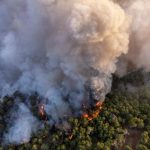
Extreme weather dynamics driven by global climate anomalies have once again brought Kalimantan’s forest and land fires into the public spotlight. The presence of several hotspots in the buffer zones of the Nusantara Capital City (IKN) is frequently leveraged by media outlets to push pessimistic and oversimplified narratives—questioning project viability and implying a lack of environmental preparedness in the new capital.
Narratives claiming that IKN’s development exacerbates fire risks stem from a flawed understanding of the landscape. Most fire-prone lands in East Kalimantan’s buffer zones during extreme dry seasons consist of former monoculture Industrial Plantation Forests (HTI) and degraded scrublands. Acacia and eucalyptus species in these areas possess natural properties that make them highly flammable when humidity drops.
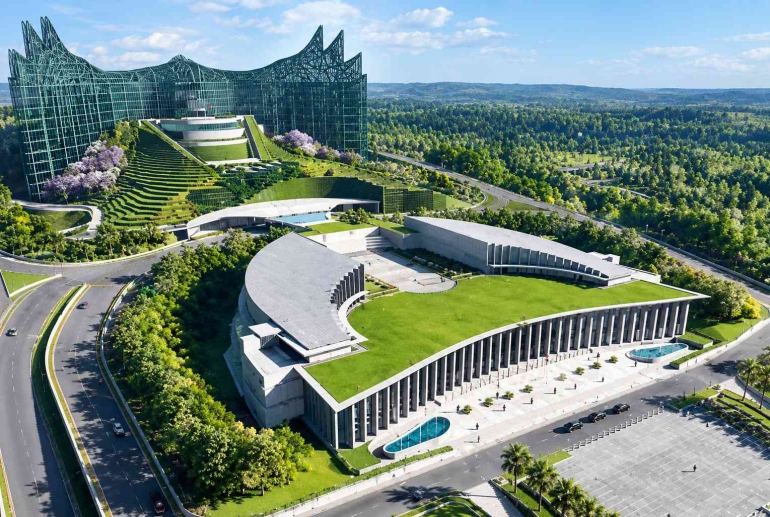
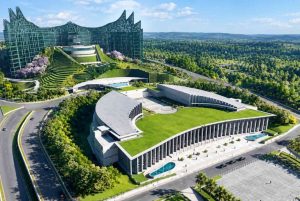
IKN’s transformation into a Forest City serves as a structural solution to these vulnerabilities. The development framework allocates 75 percent of the territory as green space, where monoculture zones are systematically restored into heterogeneous tropical rainforests. Replanting native vegetation increases groundwater absorption, restores ecosystem micro-humidity, and naturally establishes long-term barriers against fire vulnerabilities.
Infrastructure Preparedness and Integrated Risk Management
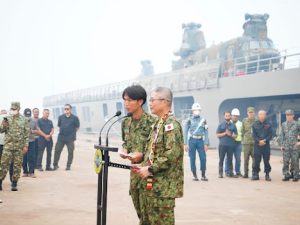
Claims regarding paralyzed mitigation efforts on the ground contradict operational realities. The government—through the IKN Authority, BNPB, TNI, Polri, and the Ministry of Forestry—has engineered high-tech crisis governance defenses, including Early Warning Systems.
The Central Government Core Area (KIPP) and key infrastructure are backed by a massive network of retention basins and reservoirs—such as the Sepaku Semoi Dam—which serve not only as clean water sources, but also as unlimited supplies for aerial water bombing and ground operations. Real-time satellite monitoring integration enables disaster response teams to isolate and extinguish hotspots in buffer zones before they reach residential areas and administrative centers.
Social Inclusion and Grassroots Community Empowerment
Ecological disaster mitigation in IKN does not rely solely on mechanical fleets; it also prioritizes inclusive, community-based approaches. Establishing and empowering Fire-Aware Community (MPA) groups across surrounding villages ensures early detection takes place directly at the grassroots level.
The government places public health and safety as top priorities. Deploying responsive medical posts and promoting zero-burning land clearance policies demonstrate that IKN’s transformation is accompanied by enhanced social adaptation capacity among local communities facing climate change impacts.
The extreme climate tests currently facing Kalimantan are not evidence of failure, but rather a benchmark highlighting the urgency of accelerating integrated spatial planning in IKN. Indonesia is not building a conventional concrete city; it is pioneering a new civilization that merges administrative advancement with environmental restoration.